What Is a Meat & Bone Cutting Band Saw Blade?
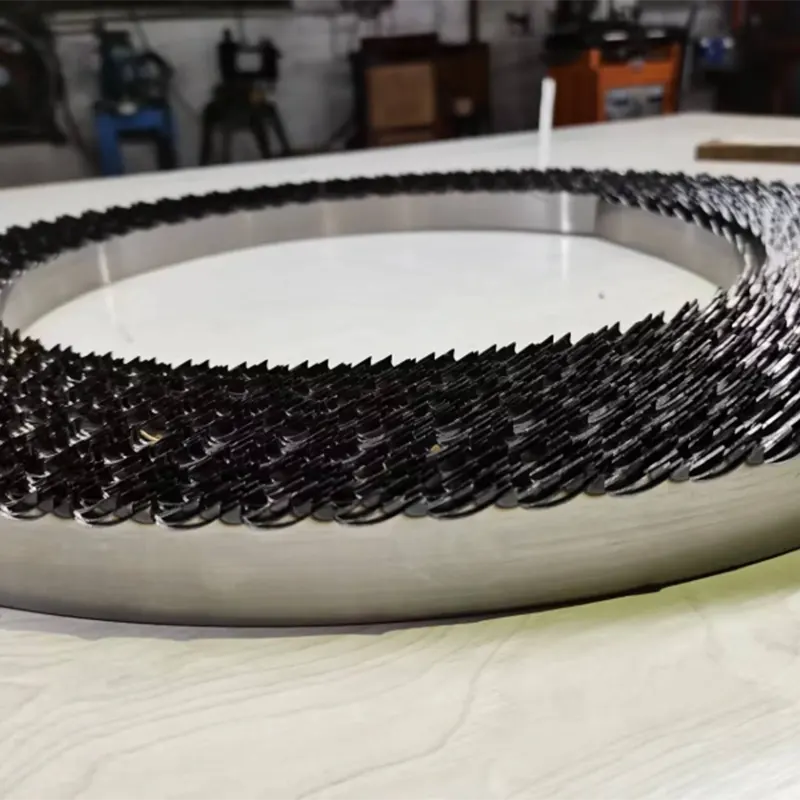
A meat & bone cutting band saw blade is an industrial blade mounted on a vertical band saw or floor-standing meat saw. It cuts continuously at high speed to portion fresh meat, bone-in cuts, frozen meat, and poultry. Unlike general-purpose metal-cutting band saw blades, meat and bone cutting blades are optimized for food processing in terms of steel selection, tooth geometry, heat treatment, and hygiene requirements.
Who Uses These Blades?
| Customer Type | Typical Requirements |
|---|---|
| Meat processing plants | High-volume bone-in meat cutting, frozen meat portioning, long blade life |
| Poultry slaughtering and processing companies | High-speed poultry cutting, clean cuts, reduced bone dust |
| Butcher shops / supermarket meat counters | Daily fresh meat cutting, bone-in ribs, safe operation, attractive cut surface |
| Food machinery distributors / equipment suppliers | OEM/ODM supply, multi-size stock, welding service support |
Core Value Proposition
-
Four steel grades for precise selection: From standard fresh meat cutting to heavy-duty frozen bone cutting, there is a suitable material for each application.
-
Hardened and tempered tooth tips: Tooth tip hardness reaches 58–67 HRC, significantly extending blade life and reducing blade change frequency.
-
Welding service and flexible supply: Blades can be welded into loops to match specific machine models or supplied as coils for customers with their own welding equipment.
-
Small-batch purchasing and custom specifications: Flexible MOQs support butchers, distributors, and first-time buyers who want to verify quality before scaling up.
Material Comparison & Selection Guide
Blade performance depends primarily on the steel grade. We offer four proven materials for meat and bone cutting:
| Material | Type | Blade Body Hardness | Tooth Tip Hardness | Key Features | Recommended Applications |
|---|---|---|---|---|---|
| C75 | High-carbon steel | 44–48 HRC | 61–63 HRC | Excellent cost-performance, sharp edge, low cutting resistance | Fresh meat, poultry, ribs, general butchering |
| C75Cr1 | Chrome alloy steel | 46–50 HRC | 58–64 HRC | Chromium improves hardenability and wear resistance; fatigue strength ≥1300 MPa | High-frequency bone-in cutting, medium-to-large processing plants |
| SK5 | Alloy tool steel | 46–48 HRC | 63–67 HRC | Highest tooth tip hardness, outstanding wear resistance, balanced toughness | Frozen meat, heavy-duty bone cutting, continuous operation |
| SK4 | Alloy tool steel | 44–48 HRC | 61–64 HRC | Balanced toughness and hardness, good resistance to breakage | Mixed cutting: fresh meat and frozen meat |
C75Cr1 can reach 58–64 HRC after quenching, with tensile strength ≥1300 MPa. In hard-state supply, the strip hardness is typically 45–50 HRC, making it a strong choice for high-strength continuous cutting. SK5 is heat-treated to achieve excellent tooth tip rigidity while maintaining toughness.
Manufacturing Process
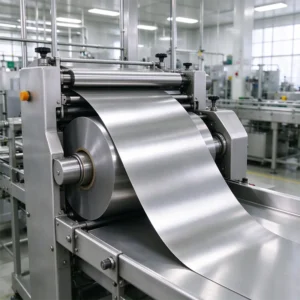
A high-quality meat & bone cutting band saw blade goes through five core processes:
1. Punching
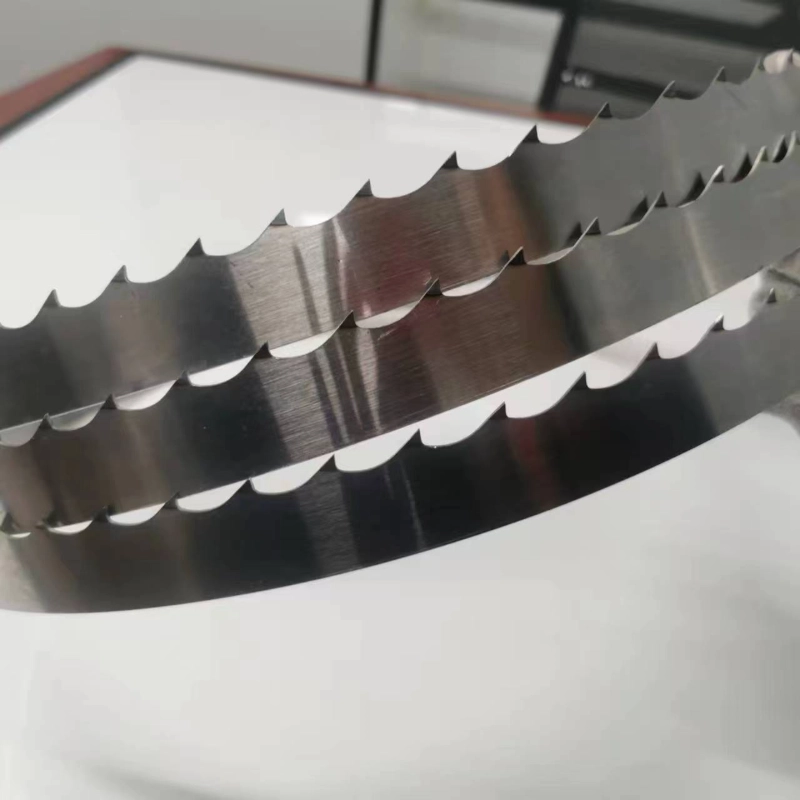
Precision dies punch uniform teeth into the steel strip. Tooth spacing and depth are controlled within ±0.02 mm, ensuring stable cutting performance.
2. Grinding
High-precision grinding machines sharpen the tooth faces. Consistent grinding directly affects cut surface quality and cutting efficiency.
3. Setting
Teeth are set left and right alternately to create cutting clearance. Proper tooth set reduces friction between the blade and the meat, lowers cutting temperature, and minimizes bone dust.
4. Tooth Tip Hardening & Tempering
This is the key process for blade life. High-frequency induction hardening heats and cools only the tooth tip, raising tooth tip hardness to 58–67 HRC while the blade body remains at 44–50 HRC for toughness. Tempering relieves internal stress and helps prevent tooth tip chipping.
5. Welding
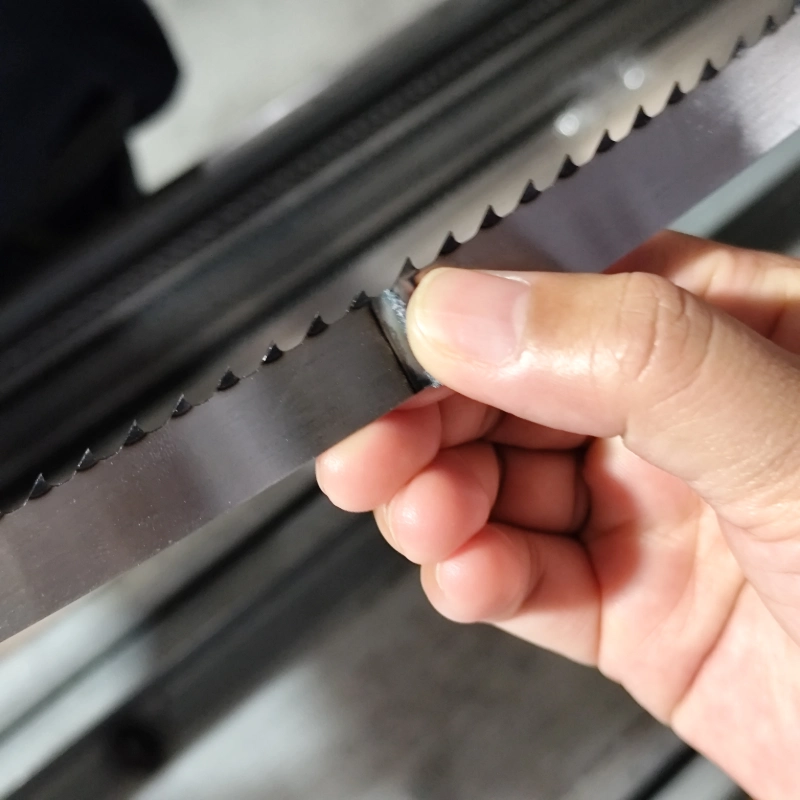
For customers who need finished loop blades, we use high-strength butt welding. The weld is smooth and aligned, with strength close to that of the parent material. Post-weld annealing prevents stress concentration at the joint.
Common Specifications & Technical Parameters
Standard Specification Table
| Thickness (mm) | Width (mm) | Tooth Pitch | Typical Applications | Typical Lengths |
|---|---|---|---|---|
| 0.50 | 16 | 3T | Bone-in meat, frozen meat, ribs | 1650 / 1840 / 2240 mm |
| 0.50 | 16 | 4T | Fresh meat, poultry, precision cutting | 1650 / 1840 / 2240 mm |
| 0.56 | 19 | 3T | Heavy-duty bone cutting, frozen meat blocks | 1650 / 2240 / 2490 mm |
| 0.56 | 19 | 4T | Bone-in fresh meat, mixed cutting | 1650 / 2240 / 2490 mm |
| 0.56 | 16 | 3T / 4T | General purpose, fits many vertical meat saws | 1650 / 1840 mm |
Other thicknesses (0.45 / 0.60 / 0.65 mm), widths (13 / 20 mm), and tooth pitches (6T) are available on request.
Tooth Pitch Selection Guide
-
3T (3 teeth per inch): Larger tooth pitch and generous chip clearance. Faster cutting, ideal for bone-in meat, frozen meat, and high-efficiency applications.
-
4T (4 teeth per inch): Moderate tooth pitch. Smoother, cleaner cut surface. Ideal for fresh meat, poultry, and applications where cut quality matters.
Key Performance Indicators
-
Blade body hardness: 44–50 HRC
-
Tooth tip hardness: 58–67 HRC depending on material
-
Tooth pitch tolerance: ±0.02 mm
-
Weld strength: ≥90% of parent material strength
-
Raw material standard: aligned with ASTM 1075 and similar high-carbon steel standards
Supply Formats & Customization
Supply Formats
-
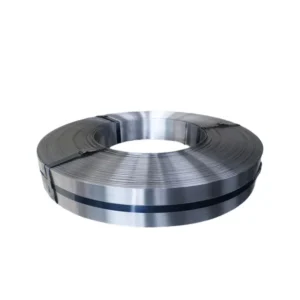
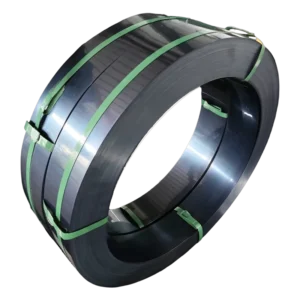
Coil: Standard 100 m/coil or 50 m/coil, wrapped in anti-rust paper and plastic film. Suitable for customers with welding equipment. Multiple coils can be packed on iron pallets with heavy-duty plastic wrapping for bulk shipment.
-
Welded Loop: Welded to the required length for your machine model. Packed 10 pieces/box, ready to install.
Customization Capabilities
| Customization Item | Range | MOQ Reference |
|---|---|---|
| Length | 1200–3930 mm, any length | Confirmed by specification |
| Width / Thickness | 13–20 mm / 0.45–0.65 mm | Confirmed by specification |
| Tooth Pitch | 3T / 4T / 6T | Confirmed by specification |
| Welded Loops | Customized to machine model | Small batches accepted |
| Branding | Logo printing / custom packaging | Confirmed by quantity |
Packaging & Logistics
-
Welded blades: 10 pieces/box, carton packaging
-
Coils: anti-rust paper + plastic film + iron pallet
-
OEM/ODM custom packaging supported
Industry Standards & Quality Assurance
Production and quality control follow recognized practices:
-
ISO 9001 quality management system alignment
-
Raw material standard: ASTM 1075 high-carbon steel for food band saw blades
-
Food safety: food-grade carbon steel suitable for meat processing hygiene requirements
-
NSF/ANSI/3-A sanitary design references available on request
For customers requiring specific certification documents, material options and documentation support can be discussed based on order requirements.
Why Choose Our Meat & Bone Cutting Band Saw Blades?
-
Complete material system: C75, C75Cr1, SK5, and SK4 cover the full range from cost-effective to high-performance. This helps customers select the right blade for each cutting scenario without over-specifying or under-specifying.
-
Controllable and traceable processes: From punching to welding, production is completed in-house. Each batch undergoes hardness testing and weld strength checks for stable, traceable quality.
-
Flexible small-batch supply: Lower trial-order barriers for butcher shops, distributors, and first-time buyers who want to verify quality before larger orders.
-
Value-added welding service: Finished welded loop blades are ready to install, reducing setup time for customers without welding capability.
-
Fast customization response: Non-standard sizes, OEM branding, and custom packaging help distributors build their own product lines.
FAQ
Q1: How do I choose between 3T and 4T tooth pitch?
3T has a larger tooth pitch and more chip clearance, so it cuts faster and is suitable for bone-in meat, frozen meat, and large cross-sections. 4T produces a smoother, cleaner cut and is better for fresh meat, poultry, and applications where cut quality matters. If you switch frequently between fresh and frozen meat, stocking both pitches is recommended.
Q2: What is the difference between C75 and SK5?
C75 is high-carbon steel with excellent cost-performance and a sharp edge. It is suitable for standard fresh meat and poultry cutting. SK5 is alloy tool steel with higher tooth tip hardness, up to 63–67 HRC, and significantly better wear resistance. It is ideal for frozen meat, heavy-duty bone cutting, and long continuous operation. In short: C75 for light-to-medium daily cutting, SK5 for heavy-duty high-frequency cutting.
Q3: What is the minimum order quantity?
We support flexible MOQs depending on specification and material. For standard sizes such as 0.50 × 16 × 3T, small trial orders are usually acceptable. Please submit a quote request with your required specification and quantity, and we will reply within 24 hours.
Q4: What is the difference between coils and welded loops? Which should I choose?
Coils are suitable for customers with band saw blade welding equipment. They can cut and weld blades to the required machine length, offering greater flexibility and lower unit cost. Welded loops are ready to install and are suitable for end users without welding capability. If you are unsure, tell us your machine model and required length, and we can weld the blades before shipping.
Q5: Which band saw machine brands are compatible?
Our blades fit most commercial meat band saw machines. If you provide the machine brand, model, or the dimensions of your old blade — length × width × thickness × tooth pitch — we can quickly match the correct specification. Custom drawings are also welcome.