How bone structure sets the lower bound of tooth pitch
Bone is not a homogeneous material. Poultry bone is thin, porous, and low in strength; pork bone sits in the middle for density and toughness; beef leg bone and spine are high-density, high-impact-load bone.The harder and thicker the bone, the coarser the pitch needs to be; the thinner and more brittle the bone, the finer the pitch needs to be to control fracturing.
The bone-to-pitch relationship that emerges from practice and supplier guidance can be summarized as:
| Bone type | Recommended TPI range | Core logic |
|---|---|---|
| Poultry fine bone (chicken frames, wing roots) | 6–10 TPI | Tight tooth spacing prevents bone cracking and bone fragment spray, and preserves bone marrow integrity |
| Pork bone (ribs, spine, shoulder) | 3–5 TPI | Medium pitch balances cutting speed against fragment control |
| Beef leg bone, large-animal high-density bone | 1–3 TPI | Coarse teeth provide large gullet capacity, withstand high impact load, and typically need hardened or carbide-tipped teeth |
MESI’s industrial blade configurations refine this logic further: 6 TPI (4.20 mm pitch) is positioned for “fresh meat with small bones” to “minimize bone breakage” and improve cut appearance, while 3 TPI (8.46 mm pitch) is used for frozen, high-throughput applications. The takeaway: bone size alone is not enough to fix TPI — it must be read together with product temperature.
Product temperature and cross-section: the same bone-on product needs different pitch frozen vs. fresh
The most common buying error is treating “bone-in” as a single category at the quotation stage. For the same bone-in product, frozen and fresh states push tooth pitch in opposite directions.
Frozen or semi-frozen product: muscle and fat lose plasticity, the hardness gap between bone and meat narrows, and overall cutting resistance rises. This calls for a coarser pitch to keep chips evacuating and feed rates up. 3 TPI is consistently recommended across sources for frozen, bone-in, large cross-section work: SimCut’s practical rule is “big, frozen, or bone-heavy → 3 TPI,” and New Zealand channel guidance likewise notes that 3 TPI “clears waste and bone dust more effectively” in frozen and bone-in cutting.
Fresh or chilled product: soft tissue dominates, and cut-face appearance and moisture retention matter more. 4 TPI is the general-purpose choice for fresh meat, poultry, and appearance-sensitive work: 6.35 mm pitch, balancing chip clearance against cut-face finish. Butcherquip’s description of 4 TPI is precise: “Coarse enough to clear bone chip instead of packing up, fine enough to leave a clean face on the cut rather than a torn one.”
Cross-section size adds a further constraint. Large beef cuts, whole pork shoulders, and frozen meat blocks need the gullet capacity of a coarse tooth; small cuts, trimming work, and thin-sliced product favor a finer pitch for control precision. If one machine has to run both frozen large bone and fresh trimming, buyers should not force a single TPI across all scenarios — instead confirm whether the machine supports quick blade changes, or quote two blade pitches as a set.
Tooth form and pitch work together: variable pitch solves what pitch alone cannot
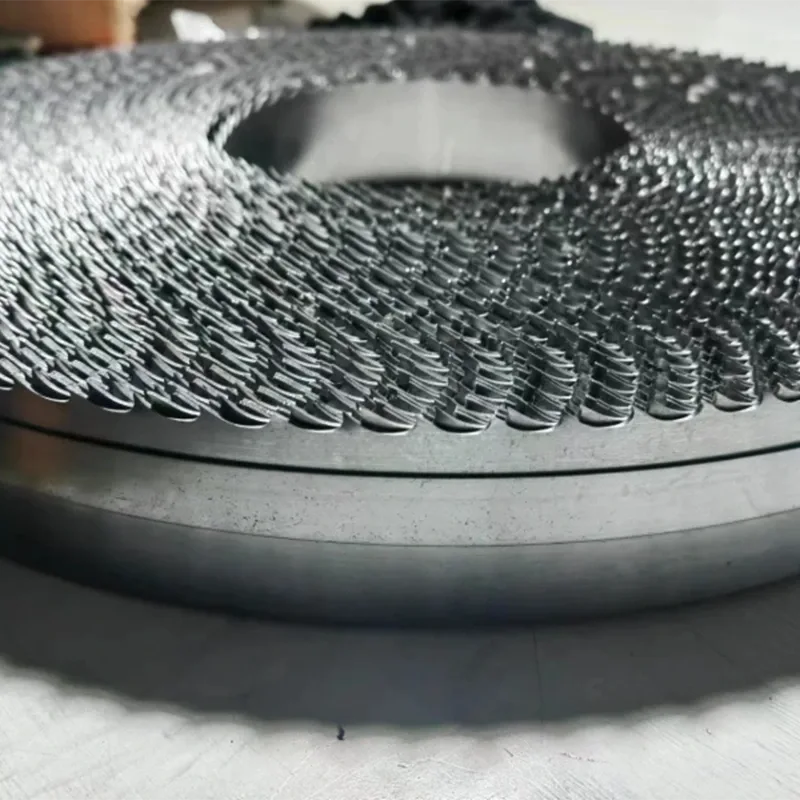
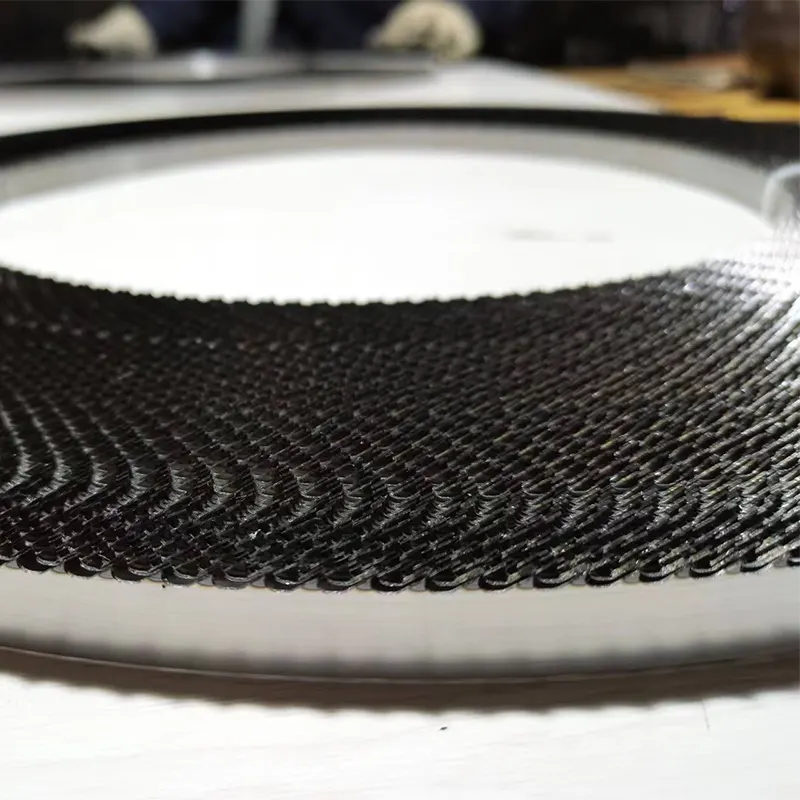
Constant pitch produces periodic vibration when cutting non-homogeneous material. Bone and meat alternate in hardness, and every tooth of a constant-pitch blade strikes the material on the same rhythm, so vibration accumulates and accelerates tooth chipping and cut-face unevenness.Variable pitch — using different pitches within a tooth group, for example alternating right, left, and raker teeth with a progressive pitch — breaks that periodic excitation. Patent literature shows variable-pitch designs reduce noise and vibration, improve cut-face finish, and reduce bone dust adhering to the finished surface.
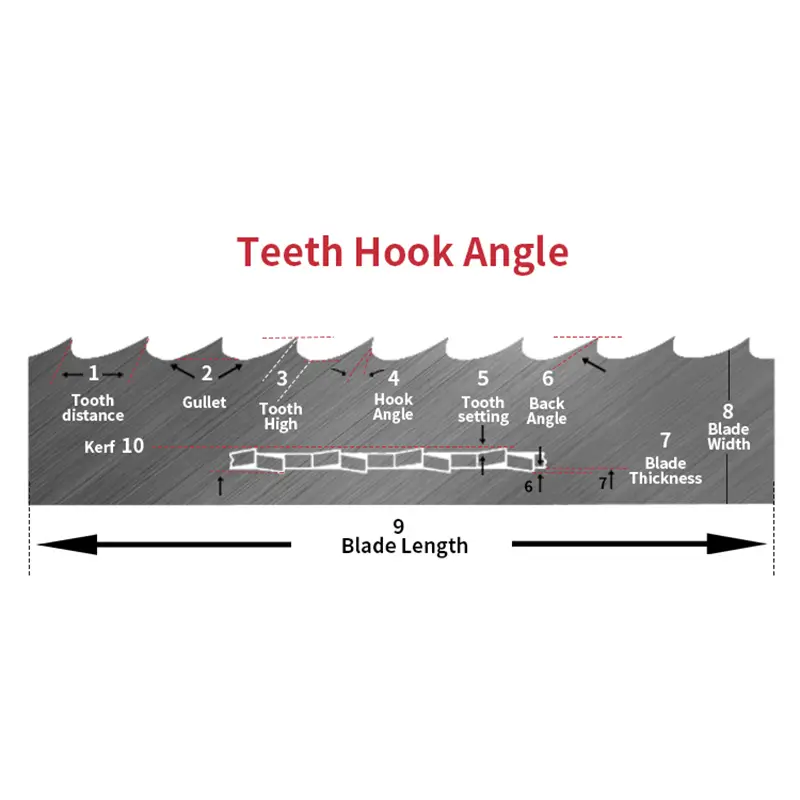
Tooth set also participates in chip evacuation and cut-face control. A typical raker set combines a non-set raker tooth with left- and right-set teeth: the raker clears the bottom of the kerf while the side teeth widen it. For meat and bone cutting, a chamfered set or a C-tooth design (adding an intermediate tooth between teeth) can further reduce residue buildup in the cutting zone.Specifying only “3 TPI” or “4 TPI” is not enough; at the same TPI, constant vs. variable pitch and standard vs. modified raker set can differ materially in actual cutting performance.
For buyers: a six-item checklist for submitting pitch and tooth-form requirements to suppliers
Buyers don’t need to be blade designers, but they do need to translate the end-use cutting scenario into spec language a supplier can execute. All six items below are required; list them line by line on the RFQ.
- Primary cutting target and bone type. Distinguish poultry fine bone, pork bone, and high-density beef bone; note whether splitting, banding, or trimming is involved.
- Product temperature states and their share. What proportion is fresh, chilled, and frozen. If frozen exceeds roughly 30–40%, the coarse-pitch direction is effectively locked in.
- Typical cross-section size range. Maximum cutting thickness and minimum trim thickness. This sets the lower bound on gullet capacity and the upper bound on cut-face quality.
- Target TPI and whether variable pitch is acceptable. State 3 TPI, 4 TPI, or a mixed requirement explicitly; if vibration and bone dust are current pain points, proactively ask whether variable pitch or modified raker set options exist.
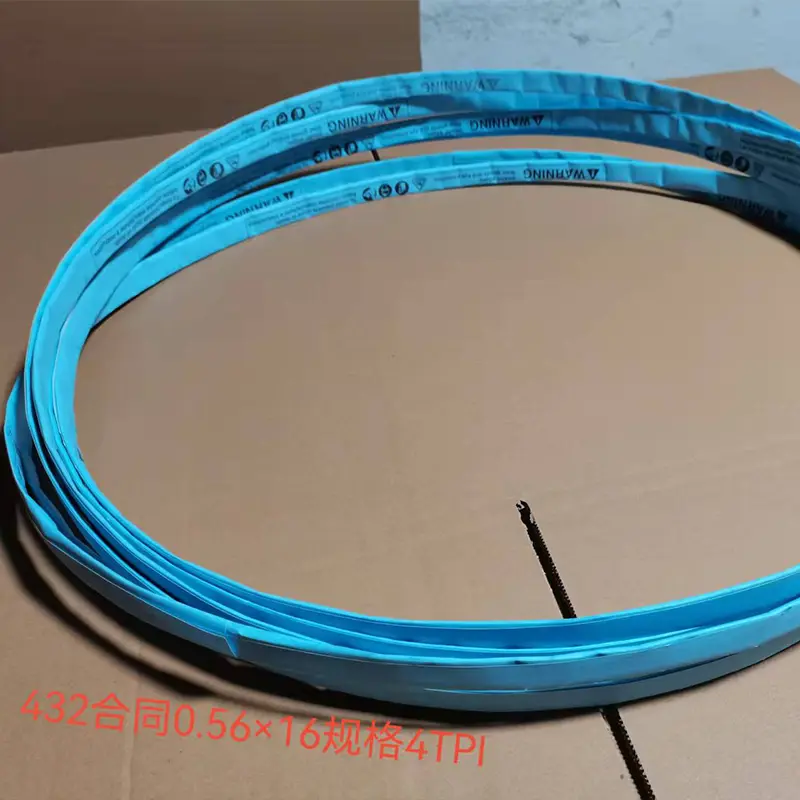
- Blade geometry. Loop length, width (commonly 16 مم / 19 مم), and thickness (commonly 0.46 مم / 0.56 مم). Along with pitch, these determine tensioning behavior and cutting stability on a given machine.
- Tooth-tip hardness and material. High-frequency hardened teeth are commonly 62–65 HRC; carbon steel and stainless steel trade off corrosion resistance against edge retention. For high-density beef bone, confirm whether teeth are hardened or carbide-tipped.
التعليمات
Q: 3 TPI or 4 TPI — which one do I actually pick?
أ: One practical rule covers most scenarios: big, frozen, bone-heavy → 3 TPI; small, fresh, appearance-sensitive → 4 TPI. If frozen bone-in product dominates the mix, 3 TPI is the safer default; if fresh trimming and poultry portioning dominate, 4 TPI performs better overall.
Q: Can I cut poultry small bone with 4 TPI?
أ: نعم, but 6 TPI has the edge on bone-fragment control and cut-face appearance. MESI lists 6 TPI (4.20 mm pitch) specifically for “fresh meat with small bones,” with the goal of reducing bone breakage. If finished-product appearance is a core KPI in poultry portioning, 6 TPI is worth evaluating first.
Q: Does a finer pitch always give a better cut face?
أ: Cut-face finish improves with TPI within a reasonable range, but past the point where chip evacuation becomes the limiting factor, packed bone dust causes heat buildup, glazed teeth, and a deteriorating cut face.The upper limit on pitch is set by chip-evacuation capacity, not by how smooth you would like the cut to be.
Q: What pitch and tooth-form information should buyers give suppliers?
أ: At minimum six items: primary cutting target and bone type; product temperature states and their share; typical cross-section size range; target TPI and whether variable pitch is acceptable; blade length, width, and thickness; tooth-tip hardness and material.