Selection overview: a three-step decision framework
Before moving into specific scenarios, use a simplified decision path to narrow the field:
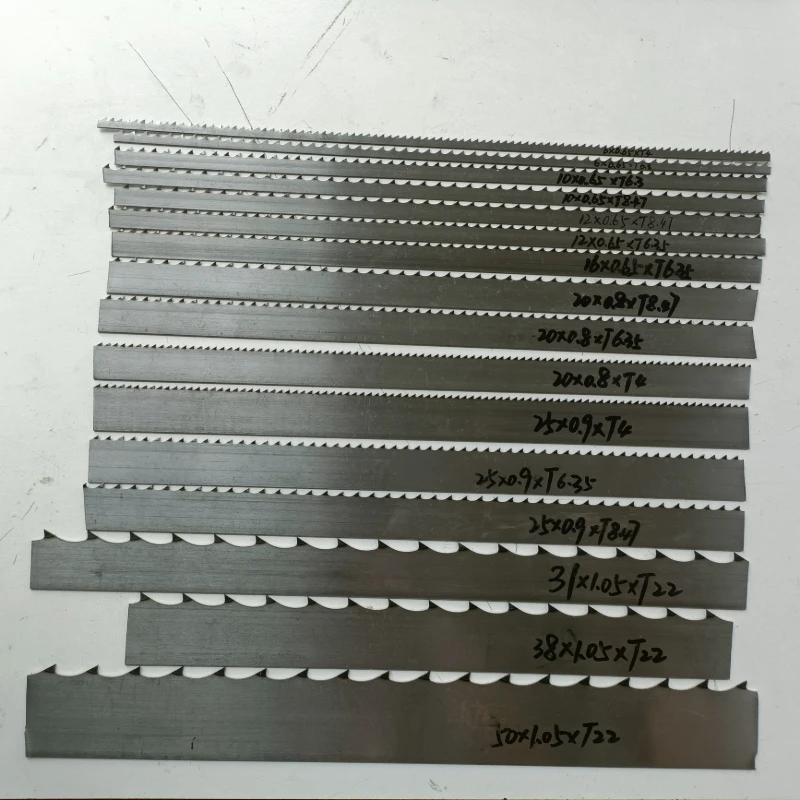
Step 1: Classify by raw material state. Fresh fish, bone-in fish, and frozen blocks correspond to different tooth-geometry families and pitch ranges. This step determines “what not to use,” which is often more important than determining “what to use.”
Step 2: Confirm machine and specification constraints. Blade length must match the wheel diameter and frame. Width affects rigidity and contour-cutting capability. Thickness must be compatible with wheel size. Forcing a thick blade onto a small-wheel machine is almost a guarantee of fatigue failure.
Step 3: Close with trial cuts. Any parameter table can only narrow the candidate list; it cannot replace actual performance on the customer’s line. Trial cuts should observe cut-surface finish, tooth breakage or band breakage, feed resistance, and changes in yield.
Scenario 1: fresh fish precision cutting
The goal in fresh fish processing is not simply “cutting through,” butcompleting the cut with minimal tissue damage. During sawing, fish muscle fibers are subjected to both tension and shear. If tooth pitch is too coarse, the cutting depth per tooth increases, and fibers are “pulled apart” rather than “cut cleanly.” The cut surface shows fraying and cell damage, which directly affects appearance and water-holding capacity in subsequent marinating, freezing, or packaging.
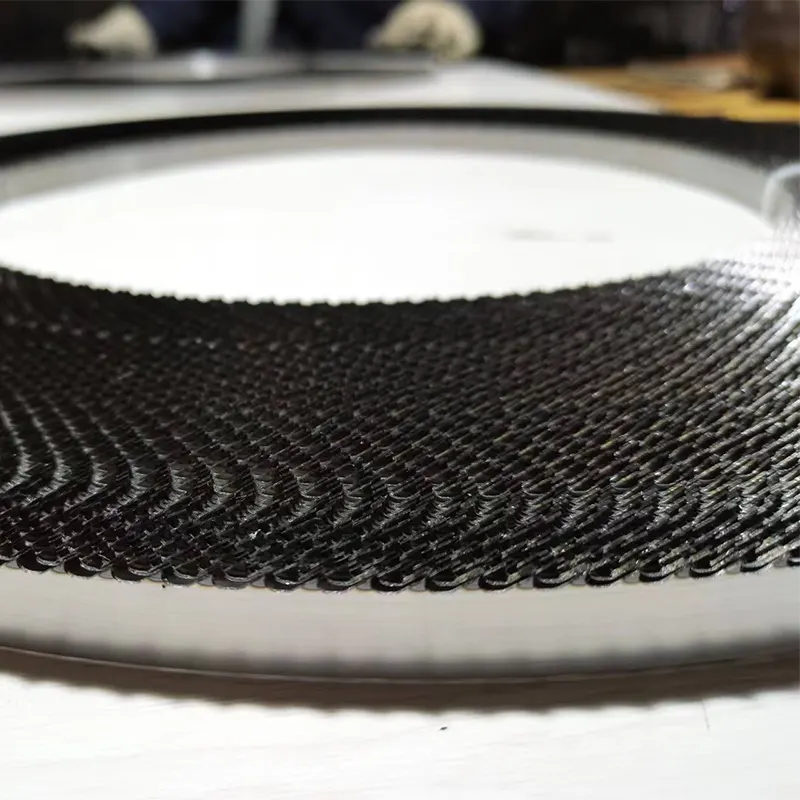
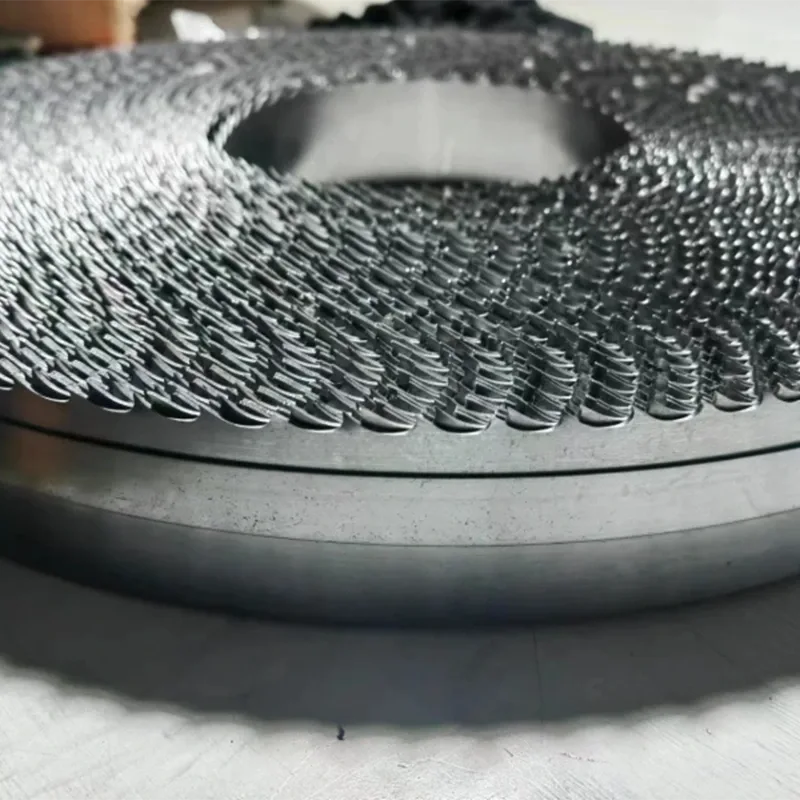
In industry practice, the mainstream pitch range for fresh fish falls in the4 TPI to 6 TPI range. 4 TPI is a common transition choice for fresh meat and fish, while the finer 6 TPI pitch is used specifically for delicate fresh fish flesh to reduce damage. In terms of tooth geometry, DB Bevel tooth geometry is used for slicing and skinning fresh fish and cephalopods, with a design aimed at reducing residue and achieving clean cuts. Some manufacturers also offer concave and convex tooth profiles, selected according to fish species and machine compatibility.
For thickness, fresh fish blades tend towardthinner band bodies. A thin blade not only reduces kerf loss but also reduces friction heat buildup during cutting. Some suppliers offer fish-processing blades at a0.36 مم thickness level, positioned to “glide through delicate fish flesh and reduce waste of high-value raw material.” But thin is not unconditional—thin blades demand higher wheel diameter and tracking accuracy, and thickness must be checked against wheel-size compatibility on small-wheel machines.
Scenario 2: bone-in fish
The selection logic for bone-in fish sits between fresh fish and frozen blocks. Fish bones differ from mammalian bones in density and mineral structure. They typically do not impose the same severe impact wear on tooth tips as beef or pork bone, but bone-in cutting still requiressufficient tooth-tip strength and chip clearance to prevent bone fragments from being pressed into the flesh or creating micro-cracks at the cut surface.
Common configurations center on3 TPI and 4 TPI. The larger gullets of 3 TPI help evacuate debris and reduce secondary crushing of bone fragments in the kerf. 4 TPI balances cut-surface finish and chip clearance, making it suitable for bone-in cuts where finished appearance matters. For material, hardened high-carbon steel is an economical and common choice, with tooth-tip hardness around 62 HRC, balancing wear resistance and re-weldability. If the line is cleaned frequently and exposed to brine, stainless-steel options should be considered—AISI 420 stainless band saw blades are USDA-approved, and their corrosion resistance directly supports cleaning and hygiene requirements.
One often-underestimated variable iskerf width. The kerf loss in bone-in cutting may look small per cut, but in continuous cutting it accumulates into a meaningful yield difference. Narrow-kerf designs—for example, on the order of 0.16 mm per side—are explicitly presented by manufacturers as a way to improve boneless yield. Selection should incorporate “loss per cut × cuts per day” into cost calculations, rather than comparing only blade unit price.
Scenario 3: frozen blocks and deep-frozen processing
Frozen blocks are the most mechanically demanding of the three scenarios. In the frozen state, fish blocks transition from a plastic body to a brittle body, and the tooth tip experiences impact loading rather than continuous shear. في نفس الوقت, industrial cutting of frozen blocks often pursues large single-pass thickness and high throughput, requiring the blade to maintain tensile strength at low temperature without embrittlement.
The lower bound of tooth pitch drops significantly. For conventional frozen blocks, 3 TPI is the most common configuration, with large gullets for efficient chip evacuation and dense cutting rhythms. When blocks are larger and frozen deeper, 2 TPI comes into play: 2 TPI blades are used for large blocks and for large fish such as tuna, marlin, and swordfish, where the larger pitch provides greater penetration. Some dedicated blades use an “alternating smaller clearing tooth” design to improve chip evacuation and stability in deep-frozen cutting.
Low-temperature performance is a hard constraint. Ordinary carbon-steel blades lose toughness in deep-freeze environments, increasing breakage risk. Blades intended for −40 °C to −60 °C conditions need to maintain low-temperature tensile strength at the material level and avoid band embrittlement. Bimetal construction—high-speed-steel teeth with a flexible backing—can provide better durability than conventional blades at −60 °C and is an engineered choice for deep-frozen large-block applications.
Yield loss in frozen block cutting must be calculated separately. Sawdust loss from sawing blocks is estimated in industry studies at7% to 12% of block weight, averaging around 10%. This means small improvements in kerf width and chip-evacuation efficiency can have substantial economic significance when multiplied by volume. The combination of narrow kerf, thin band body, and well-designed gullets is the main lever for reducing loss in frozen applications.
Equipment matching: length, width, thickness, and tension
A blade’s performance ceiling is set by the saw. Selection that ignores machine constraints cannot run reliably, no matter how “correct” the parameters look.
Length must match the wheel diameter and frame. Length deviation prevents proper tension from being established or imposes extra stress on bearings. For non-standard machines, custom-welded loops are a common solution, but weld-joint flatness should match the parent material.
عرض is a trade-off between rigidity and contour-cutting capability. Narrow blades around 12 mm suit curved cutting and trimming. The 16 mm class is the most general-purpose middle specification. The 19–20 mm class is used where higher rigidity and straightness are required, such as carcass splitting and frozen products. In fish processing, 16 mm width with a thin body is a common starting point, but the machine manual must confirm the allowable range.
سماكة is strongly related to wheel diameter. Using a blade that is too thick on a small-diameter wheel increases bending stress amplitude, and fatigue cracks initiate earlier at the weld or tooth root. Small benchtop fish saws typically recommend thin bands on the order of 0.020 in (about 0.50 مم) to maintain flexibility. In frozen applications, thickness must also be considered together with low-temperature toughness: a thicker band provides rigidity, but if the material lacks low-temperature toughness, increasing thickness does not solve brittle fracture.
Tension is the leading cause of band breakage. Industry experience offers reference ranges: about25,000–30,000 psi for 1/2 in width and about35,000–40,000 psi for 3/4 in width, but the machine manual’s specified value must take precedence. Insufficient tension causes blade tracking problems and crooked cuts; excessive tension directly shortens band life. Fish-processing machines usually have tension indicators or adjustment mechanisms. After a blade change, tension should be recalibrated rather than carried over from the previous blade.
Specification confirmation checklist
Before ordering or trial cutting, confirm each of the following fields rather than relying on a vague memory of “the same as last time”:
| Item to confirm | Information needed | Why it matters |
|---|---|---|
| Saw model and wheel diameter | Manufacturer, model, wheel diameter | Determines allowable thickness and minimum length |
| Blade length | Measured from old blade or manual specification | Length deviation directly prevents proper tension |
| Blade width | Machine allowable range | Rigidity, contour capability, guide compatibility |
| سماكة | Allowable value matched to wheel diameter | Excessive thickness leads to fatigue breakage |
| Raw material state | Fresh/frozen, bone-in/boneless, temperature | Determines pitch and material direction |
| Target cut | Finish requirement, allowable loss | Balances pitch and yield |
| Cleaning and hygiene conditions | Cleaning frequency, sanitizer type, brine exposure | Carbon steel vs stainless steel |
| Daily volume/continuous run time | Hours, feed speed | Wear resistance and tooth-material grade |
Trial cuts: where the parameter table ends and the production line begins
Any selection recommendation—including the parameter ranges in this article—can only narrow the candidates to two or three blades.The final judgment must come from trial cuts under customer conditions. A structured trial-cut process typically includes several non-skippable steps: a complete operating-condition questionnaire covering machine, fish species, problem, and dimensions; supply of a continuous coil or welded loop sample; actual running on the customer’s line with recorded cutting performance; and data analysis of tooth breakage, band breakage, cut quality, feed resistance, and yield changes.
During trial cuts, pay particular attention to several “silent failure modes.” A cut may look intact while the fish cross-section has micro-tearing, which can become an appearance defect after freezing or thawing. A blade may perform normally at the start of a trial but show early tooth breakage after several hours of continuous operation, pointing to tooth-material wear resistance or weld quality. In frozen-block trials, gradually rising feed resistance may indicate poor chip evacuation, with debris being re-compacted in the kerf. These signals do not appear on a supplier’s parameter sheet; they can only be captured through structured trial-cut records.
التعليمات
Can fresh fish and frozen blocks use the same blade?
Not recommended. Fresh fish requires finer pitch and a thinner band body to reduce tissue damage and kerf loss, while frozen blocks require larger gullets and low-temperature toughness to withstand impact loading. A “compromise” blade often fails to achieve optimal cut quality and life at either end.
Should bone-in fish use 3 TPI or 4 TPI?
Both fall within the common range for bone-in fish. 3 TPI has stronger chip-evacuation capability and suits coarser bone structures or applications where cutting speed is prioritized. 4 TPI produces a cleaner cut and suits splitting where finished appearance requirements are higher. The final choice should combine fish species, bone density, and target cut quality, and be confirmed through comparative trial cuts.
Is a stainless-steel blade always “better”?
Stainless steel solves corrosion and hygiene problems; it is not a universal upgrade in cutting performance. Food-grade stainless steels such as AISI 420 offer clear advantages in lines with brine exposure and frequent cleaning, and their rust resistance and sanitizer resistance directly support food-safety systems. But if the line is dry and cleaning frequency is low, high-carbon steel with hardened teeth may be more suitable in cutting efficiency and cost. Material selection should be driven bycleaning regime and exposure environment, not by a vague “upgrade” logic.
Where does yield loss in frozen block cutting mainly come from?
Sawdust loss is one of the main sources, estimated in the industry at 7%–12% of block weight. Directions for reducing this loss include narrow-kerf design, pitch matched to block thickness, and effective gullet evacuation. But yield optimization cannot come at the expense of cut integrity—over-pursuing narrow kerf can lead to poor chip evacuation and cut tearing, which increases trimming loss instead.
How many samples and how long a run are needed for a trial cut?
This depends on the line’s continuous-operation characteristics. For continuous processing, the trial should cover a typical production shift or at least enough continuous run time to reveal early signals of weld fatigue and tooth-tip wear. Sample forms should include themost challenging specifications in actual production—largest block, lowest temperature, hardest bone structure—rather than testing only “easy-to-cut” raw material.
What is the most common cause of band saw blade breakage?
Improper tension is the leading cause—too tight directly increases band stress, while too loose causes tracking problems and cyclic impact. Next are thickness mismatched to wheel diameter, excessive clearance after guide-bearing wear, and inconsistent weld-joint quality. Band breakage is rarely the result of a single factor; troubleshooting should examine tension settings, wheel-diameter matching, and guide condition simultaneously.