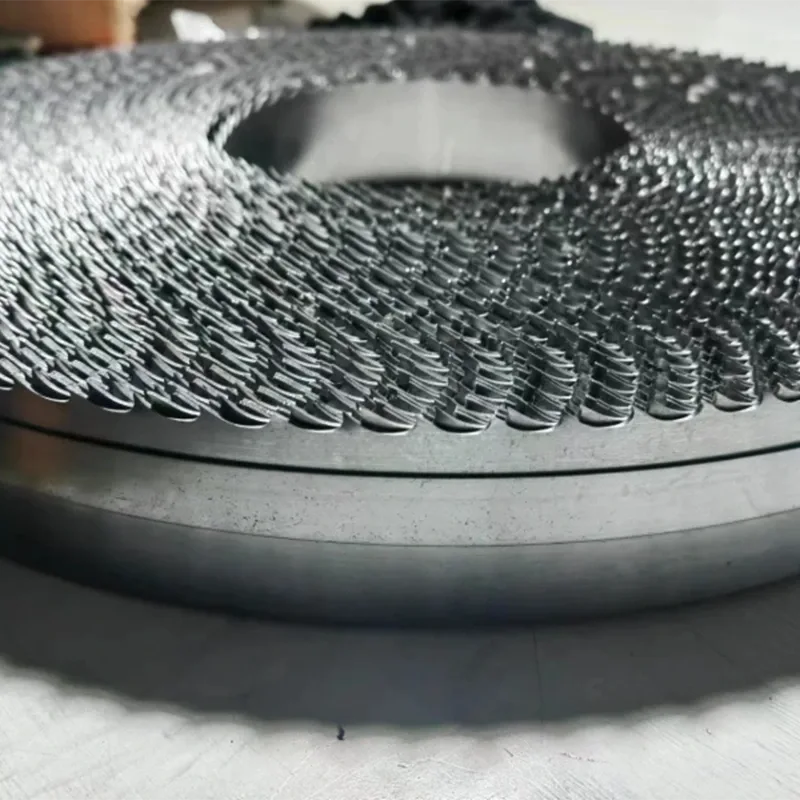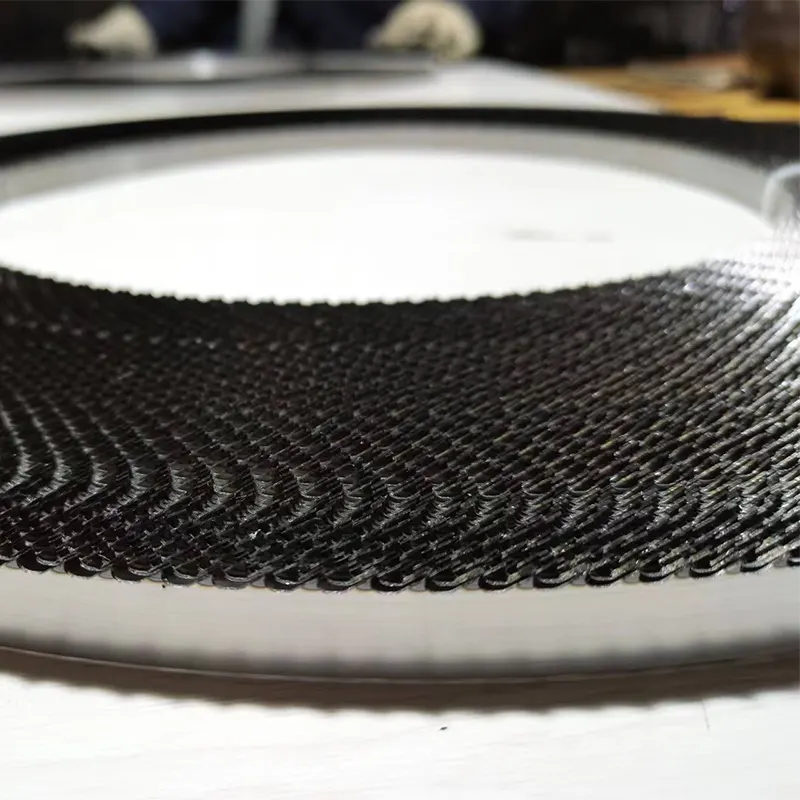
Why steel strip quality is the first quality gate in band saw blade manufacturing
Band saw blades operate undercyclic bending stress, not merely static cutting force. The blade body bends repeatedly over the wheels, the teeth absorb impact, and the weld zone experiences thermal effects. Any fluctuation in these areas can be amplified into blade breakage, deviation, or early failure.
In saw-blade manufacturing practice, WINTERSTEIGER points out that strip production quality has a decisive influence on band saw blade quality. Straightness, flatness, surface condition, and thickness dimensional accuracy must not only meet specifications; they should also showno significant variation across large blade batches. Only when these conditions are met simultaneously can consistent accuracy be maintained through milling, grinding, and tooth setting. This means a strip supplier delivers not just “a coil that meets a standard,” but areproducible dimensional and metallurgical condition.
From a failure-mechanism perspective, the backing strip plays a particularly critical role. In bi-metal band saw blades, high-speed steel teeth perform the cutting, while the backing strip carries bending fatigue and maintains guiding stability. Patent literature gives functional thresholds: final tooth hardness of at least65 HRC and backing-strip hardness of at least470 الجهد العالي to suppress edge deflection and provide sufficient guiding stiffness. في نفس الوقت, the backing strip must combinehigh bending fatigue strength with good toughness; otherwise, fracture may occur in the blade body rather than at the teeth. This explains why strip hardness cannot simply be “as high as possible” in isolation—it must be matched with toughness, cleanliness, and flatness.
How do thickness tolerances affect tooth accuracy and cutting stability?
Thickness is one of the most “silent” yet most common sources of error in band saw blade manufacturing. Milling or grinding feed references, lateral clearance for tooth setting, and weld alignment all use strip thickness as a direct reference. Thickness variation translates into inconsistent tooth height, pitch deviation, and unbalanced lateral forces during cutting.
Typical tolerance levels for precision strip provide a reference: band-saw-blade hardened and tempered steel strip often controls thickness tolerance at±0.01 mm max and width tolerance at±0.05 mm max. Precision strip for food-cutting tools can go further with T2/T3 tolerance grades; على سبيل المثال, in the 0.200–0.400 mm thickness range, T3 tolerance is±0.008 mm. The point is not “tighter is always better,” but whethertolerance capability matches the target blade type. Narrow woodworking and food-cutting blades are more sensitive to thickness consistency, while wide metal-cutting blades also need to control transverse thickness distribution (crown) because of its effect on guiding behavior.
More importantly, thickness accuracy and flatness are not independent variables. If reduction allocation during cold rolling is unreasonable, flatness deterioration or edge cracking may be introduced while achieving thickness accuracy. Conversely, over-pursuing flatness may compromise thickness uniformity. Therefore, when evaluating a supplier, do not look only at a single tolerance number. Examine whether its cold-rolling process hascombined thickness–flatness control capability.
Why do flatness and straightness directly determine whether a blade “runs straight”?
Flatness and straightness are the geometric prerequisites for a band saw blade to maintain a straight cut at high speed. Any local buckle, wave, or camber in the blade body is converted into lateral guiding force under tension, leading to inclined cutting surfaces, blade deviation, and even tooth-tip chipping caused by lateral impact.
In practice, acceptable flatness benchmarks vary by application. Woodworking band saw blade strip often requires straightness deviation within3 مم / 5 م; more demanding precision applications require flatness deviation≥ 1 مم / 3 م to prevent blade deviation during high-speed cutting. Waelzholz emphasizes “extremely low straightness deviation” for its martensitic hardened and tempered saw strip and notes that this affects not only cutting performance but also the stability of welding and grinding operations. Cgood Steel also lists “flat, free from pits, breaks, and twists” alongside deburred edges as a basic condition for downstream cutting accuracy and scrap control.
For blade makers, batch-to-batch stability of flatness is more important than the absolute value. If flatness drifts trend-wise from the head to the tail of a coil, the alignment conditions for weld joints change continuously across the coil, forcing a narrower process window. A good strip supplier controls this drift through post-cold-rolling straightening and coiling control, keeping it within a predictable range rather than relying on the blade plant to “correct” it downstream.
How do heat-treatment condition and microstructure affect fatigue life and edge performance?
The heat-treatment condition of band-saw strip directly determines the balance ofstrength, صلابة, and wear resistance. Hardened and tempered strip is mainstream in band saw blade manufacturing, with typical hardness ranges from44-46 لجنة حقوق الإنسان to46–49 HRC, depending on blade type and tooth-material matching. But for bi-metal backing strip, looking at HRC alone is insufficient: the backing strip must retain sufficient bending fatigue resistance after compounding with HSS tooth material, لحام, and final heat treatment.
Microstructure control in cold-rolled tool steel strip is the foundation of this capability. Taking 75Cr1 cold-rolled strip as an example, if cementite particle size is poorly controlled, coarse and non-uniform microstructures can form, impairing fatigue life and edge wear resistance while accompanying edge cutting damage and reduced flatness/thickness accuracy. The design goal of spheroidizing annealing is precisely to obtainfine, dispersed spherical carbides and to avoid deformation and cracking during cooling through staged control, thereby stabilizing dimensional accuracy and surface quality.
For bi-metal backing material, microalloying offers further adjustment space. Research on niobium-microalloyed X32 strip shows that after quenching at 1,050 °C and tempering at 500 درجة مئوية, the finished product can reach50.5 HRC, tensile strength of1,548 MPa, elongation of14.5%, and longer service life in idle-running life tests. This data shows thatheat-treatment schedule and strip chemistry must be evaluated as a system. The supplier’s “delivery hardness” is only a starting point; what the blade maker really needs is reproducible final performance under its own compounding and heat-treatment process.
A frequently overlooked risk is surface oxidation and decarburization. Cold-rolled strip for saw-blade bodies may form an oxide layer dominated by Fe₃O₄, with a transition zone at the oxide–matrix interface where Cr, من, and C are depleted. Such hidden defects may not be fully removed during subsequent grinding, yet they can become fatigue-crack initiation sites or weaken welds. Controlling atmosphere annealing and surface finishing quality is therefore as important as hardness metrics.
Specification matching: how should thickness, width, and hardness align with blade type?
There is no absolute definition of “good strip,” onlystrip aligned with the target blade type and manufacturing process. Specification matching involves at least three dimensions:
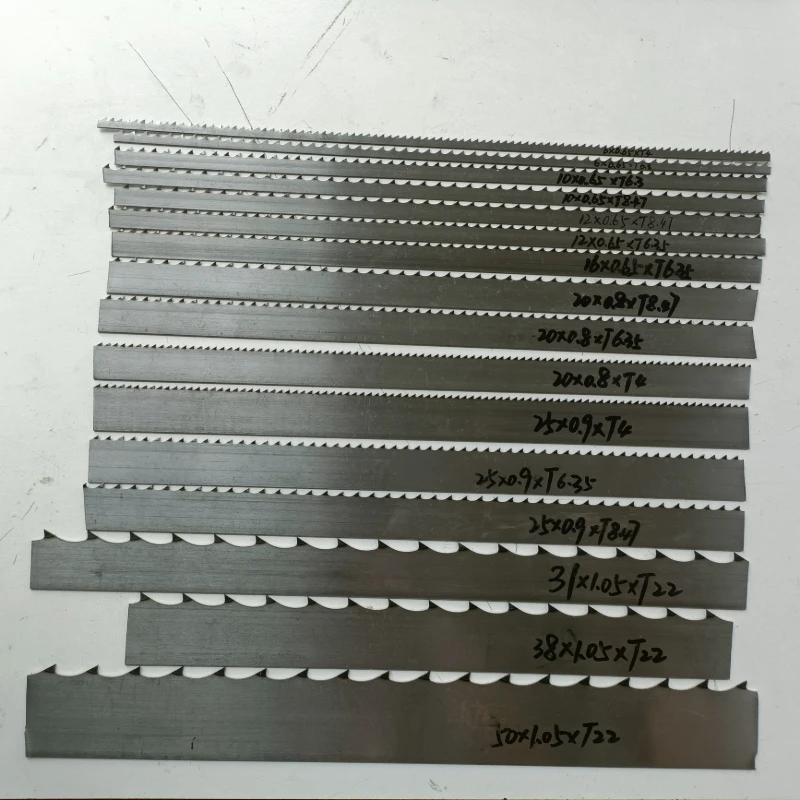
Thickness and width. Common thickness for band-saw strip ranges from0.40–3.05 mm, with widths from10–450 mm, covering narrow woodworking blades to wide metal-cutting blades. Food-cutting and precision narrow-strip applications can extend to thinner gauges (from 0.10–3.0 mm) and narrower widths (from 5 مم), while precision strip lines can achieve thickness control at the±0.003 mm level. Blade makers should require suppliers to statetolerance capability for the specific thickness–width combination, rather than accepting a “general tolerance” detached from the actual specification range.
Hardness and tooth-material matching. Bi-metal backing-strip hardness must be compatible with the final heat-treatment schedule of the HSS tooth material. Too hard a backing strip sacrifices toughness and weldability; too soft leads to insufficient guiding stability and edge deflection. The 470 HV backing-strip hardness lower limit is a functional reference, but the actual selection should be based on a comprehensive assessment of blade line speed, workpiece abrasiveness, and wheel diameter.
Surface condition and edge quality. Polished surfaces (blue, yellow, white, gray-blue, bright, etc.) affect not only appearance but also weld wetting and grinding-burn risk. The choice of round edge, rolled edge, or square edge depends on subsequent milling/grinding processes and tooth-setting method. Whether a supplier can maintainbatch consistency of edge quality within the same specification is more practically meaningful than whether it offers many edge options.
Batch quality management: why does “this coil passes” not equal “every coil is usable”?
In high-volume band saw blade manufacturing, the real hidden cost is not the absolute performance shortfall of a single coil, butprocess-window drift caused by batch-to-batch variation. Systematic offset within the thickness tolerance band, trend-wise changes in flatness, and coil-to-coil differences in hardness distribution all force blade makers to frequently adjust welding parameters, grinding compensation, and tooth-setting settings, ultimately reducing yield and delaying delivery.
Leading strip suppliers’ batch-management practices offer evaluation dimensions worth borrowing. First, simulated quench hardness uniformity verification: sample both ends of each coil and verify hardness uniformity after simulated heat treatment, not merely random inspection of delivery-state hardness. In one case, after introducing this control, the rejection rate of trial batches dropped from7–8% to below 1.5%. Second, full-process traceability: process parameters and inspection results from cold rolling, spheroidizing annealing, and hardening/tempering should be traceable to the coil number, so that when an abnormality occurs at the blade manufacturing end, the cause can be quickly located on the strip side or the processing side. Third, front-loaded batch consistency metrics: specify in supply agreements thebatch-to-batch standard deviation or maximum range limits for thickness, flatness, صلابة, and surface condition, not only single-coil pass/fail criteria.
A practical supplier-audit action for blade makers is to requestinspection data for three consecutive batches of the same specification, and observe whether the thickness tolerance band position drifts, whether the flatness distribution is stable, and whether the hardness range is controllable. This reveals a supplier’s process-control capability far better than auditing a single coil’s COA.
How to select a steel strip supplier for band saw blade manufacturing: an actionable evaluation checklist
The following checklist is prioritized for new supplier introduction and annual review of existing suppliers.
① Dimensional and flatness capability (mandatory). Does the supplier clearly state thetolerance grade for the target thickness range (e.g., T2/T3 or ±0.01 mm) وquantitative benchmarks for flatness/straightness (e.g., ≤1 mm/3 m or 3 mm/5 m)? Does the data covercoil head, middle, and tail, not only a mid-coil sample?
② Heat-treatment condition and microstructure evidence (mandatory). Is the delivery condition hardened and tempered, cold-rolled annealed, or spheroidize-annealed? Can the supplier provide ametallographic report demonstrating that carbide size and distribution meet expectations? For bi-metal backing strip, does the supplier understand thefinal performance targets after compounding with HSS tooth material, and can it provide reference data under the customer’s heat-treatment schedule?
③ Consistency of surface and edge quality (key verification). Are there control data for decarburization/oxide-layer depth? Is deburring and edge-rounding quality stable across batches? Are there periodic roll marks or scratches on polished surfaces?
④ Batch quality management system (differentiator). Does the supplier performhead-and-tail simulated performance verification? Can it provide process-capability data for consecutive batches (Cpk or range)? Does quality traceability cover the full cold-rolling–annealing–finishing chain?
⑤ Engineering support for specification matching. Is the supplier willing to recommend thickness–hardness–edge combinations based on blade type (metal cutting / woodworking / food) and manufacturing process (milling / grinding / welding method), rather than supplying only from stock specifications?
التعليمات
Q: Is ±0.01 mm strip thickness tolerance always sufficient for band saw blade manufacturing?
أ: It depends on blade type and width. For narrow precision band saw blades and food-cutting blades, ±0.01 mm may be a basic requirement, and some applications need tighter T3-level tolerances (e.g., ±0.008 mm). For wide industrial band saws, transverse thickness distribution and flatness often have more practical impact than a single thickness tolerance number. The key is whether the supplier can consistently maintain the stated tolerance grade for thetarget thickness–width combination.
Q: Is higher backing-strip hardness always better?
أ: No. Bi-metal backing strip must balance high hardness with bending fatigue toughness. Too low a backing-strip hardness leads to insufficient guiding stability and edge deflection; too high may sacrifice toughness and welding compatibility. 470 HV is a functional lower-limit reference, but the actual optimum range should be determined jointly by blade service conditions and the compounding heat-treatment schedule.
Q: What happens if flatness meets specification but drifts between batches?
أ: Batch-to-batch flatness drift forces blade makers to frequently adjust weld alignment, grinding compensation, and tooth-setting settings, narrowing the process window and reducing yield. Even if each coil’s flatness is “within tolerance,” trend-wise drift still means theprocess is not under control. Evaluation should focus on the distribution of consecutive-batch data, not single-coil pass/fail judgment.
Q: For band saw blade manufacturing, should cold-rolled annealed strip or hardened and tempered strip be selected?
أ: It depends on the blade manufacturing flow. If the blade plant has full hardening and tempering capability and wants greater control over the final mechanical properties of the backing strip, cold-rolled annealed (spheroidize-annealed) strip is a common choice. If the goal is to reduce variables in the heat-treatment step and move directly into milling/welding, hardened and tempered strip is more suitable. Neither route is inherently superior; the depth of the supplier’s process control on the chosen route is the real quality divide.