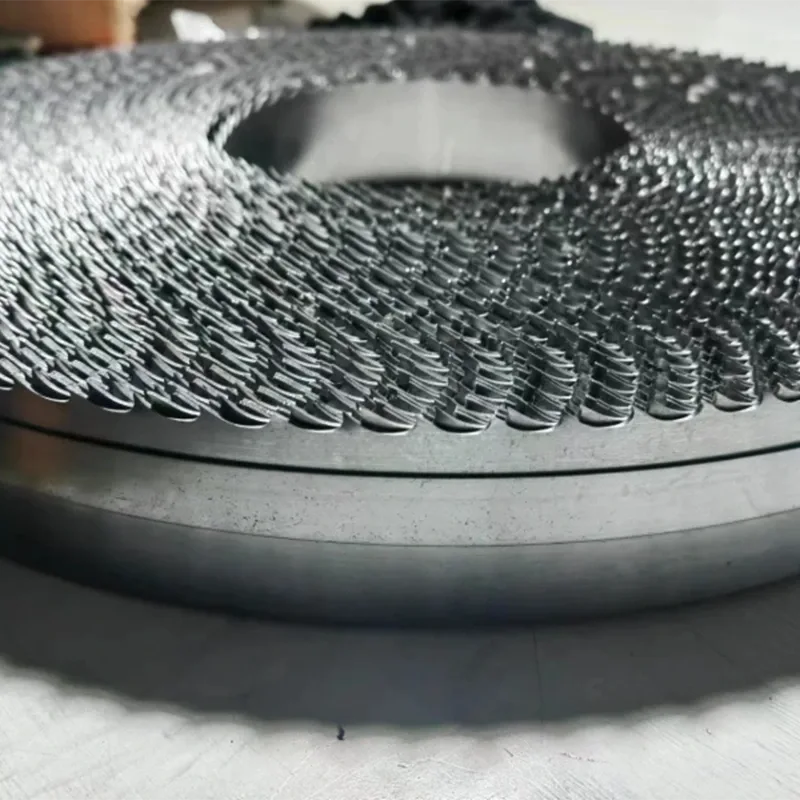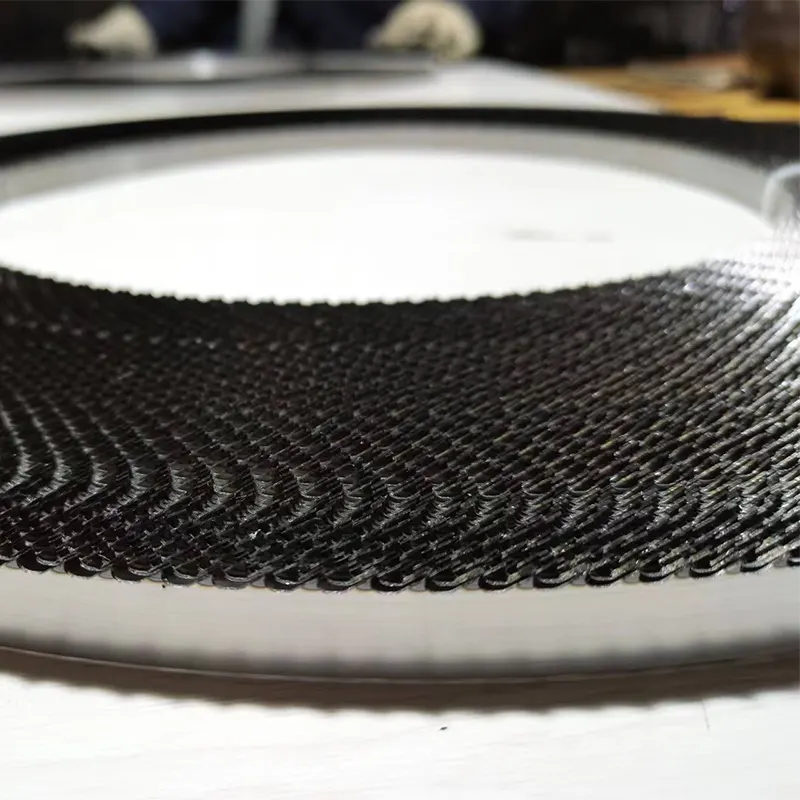
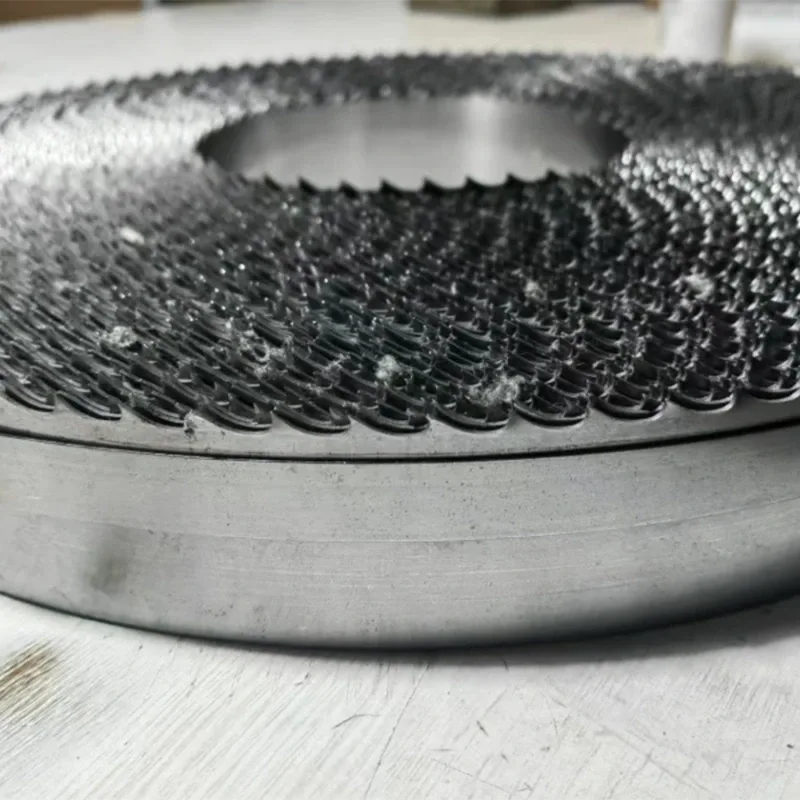
Quick answer: How should frozen meat band saw blades be selected?
Start by defining the frozen product condition and the machine’s physical limits. Then shortlist blades by TPI, tooth form, material, ancho, and thickness. Run a controlled trial cut using the actual product and record cut straightness, feed resistance, chip form, blade temperature, and product loss. Do not standardize a blade specification until it has performed acceptably in the real production condition.
1. First clarify the frozen state: “frozen” is not a single condition
Frozen meat can be roughly divided into three cutting conditions, each with different blade requirements.
| Frozen condition | Typical condition | Main blade demand | Selection implication |
|---|---|---|---|
| Deep-frozen hard product | Approximately -18°C and below | Resistencia al impacto, chip clearance, heat resistance at tooth tip | Coarser TPI and robust tooth form are usually more relevant than “sharpness” alone |
| Semi-frozen / tempered product | Approximately -2°C to -8°C | Balanced feed resistance and surface quality | Can be closer to fresh-meat cutting, but chip clearance and feed force still matter |
| Bone-in frozen product | Frozen meat with bone | Tooth impact resistance and mixed-chip clearance | Usually needs coarser TPI; fine teeth risk packing and tooth chipping |
Temperature alone is not enough. Ice crystal structure, fat content, block thickness, maximum cross-section, bone ratio, and freezing history can all change cutting behavior. Some frozen-meat blade lines, such as Starrett Meatkutter Frozen, are marketed for temperatures down to approximately -20°C, but product-specific trial cuts remain necessary.
Selection implication: Confirm the actual frozen condition before discussing TPI. A TPI number without temperature, block size, and bone content is not a selection decision.
2. The four blade specification dimensions
2.1 TPI: coarse teeth help the blade survive; fine teeth help the cut look better
The most common frozen-meat choice is a trade-off between3 TPI y4 TPI.
| Especificación | Advantages in frozen meat | Risks / limits | Best starting point |
|---|---|---|---|
| 3 TPI | Larger gullet, better chip clearance, lower risk of packing, lower heat concentration per tooth | May produce a rougher cut surface | Deep-frozen, large-block, bone-in, high-feed-force cuts |
| 4 TPI | Smoother cut surface, suitable for smaller or lower-bone products | Higher feed resistance and faster tooth wear in deep-frozen or heavy-bone conditions | Semi-frozen, small-block, low-bone, surface-sensitive cuts |
Many meat processors and supermarket frozen-meat stations use3 TPI as a default starting point because the larger tooth space handles hard frozen surfaces and higher feed force better.4 TPI is a candidate for smaller, semi-frozen, low-bone products, but it should be compared against 3 TPI in a trial cut. Some equipment guidance suggests that machines running below approximately 4,000 fpm may perform better with 4 TPI, but this must be evaluated together with frozen product condition—not as a standalone rule.
2.2 Tooth form and rake angle: hook teeth help establish bite
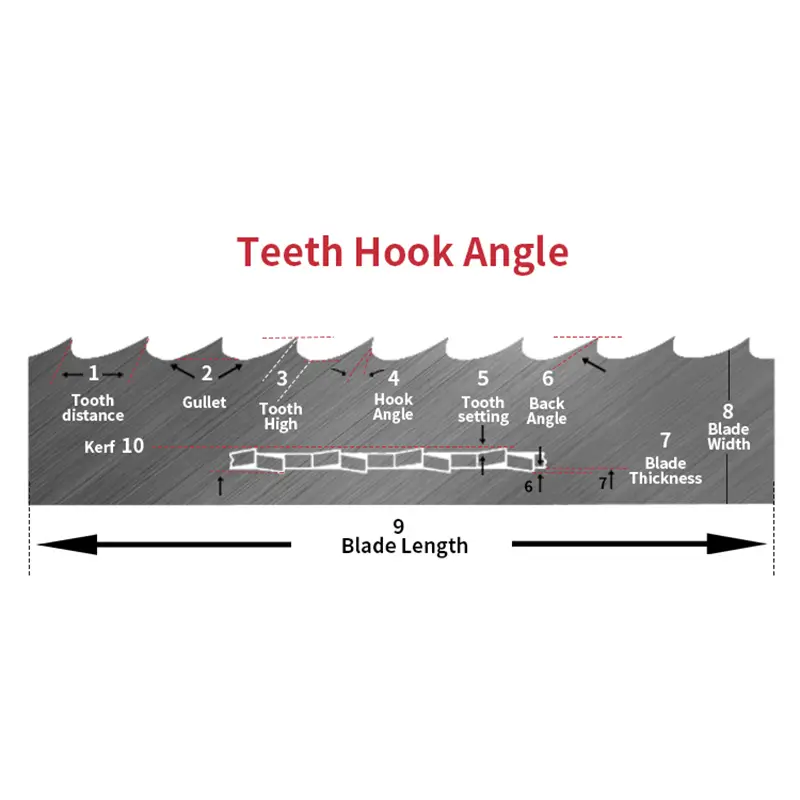
Frozen-meat blades commonly use ahook tooth form with positive rake. The design intent is to let the tooth tip “dig” into the frozen surface rather than scrape across it, helping establish initial penetration and reducing the risk of skidding.
Some frozen-meat blades use alow-profile hook design. This keeps a positive rake while reducing tooth height, which can lower peak cutting force per tooth on very hard frozen product and reduce the risk of tooth chipping. If the product is extremely cold or contains large ice crystals, a low-profile hook design may be worth including in the trial comparison.
2.3 Material: acero carbono, bi-metal, and carbide have different roles
| Material | Suitable scenario | Ventajas | Limits |
|---|---|---|---|
| Carbon steel | Intermittent, light-duty, small-batch, cost-sensitive cutting | Lower initial cost, widely available | Lower heat resistance and wear resistance in continuous deep-frozen cutting |
| Bi-metal | Commercial stations running several hours per day | Better balance of tooth wear resistance and backing fatigue resistance | Higher cost than carbon steel |
| Carbide | High-bone, very low-temperature, or extreme blade-life requirements | High wear resistance | Higher cost; should be validated as an upgrade after bi-metal proves insufficient |
Bi-metal is often a practical baseline for commercial frozen-meat stations. Carbide should not be treated as a default starting point; it is better viewed as an upgrade path when trial cuts show that bi-metal blade life is insufficient.
2.4 Width and thickness: often overlooked constraints
Blade width affects straight-cutting stability.
- 12–13 mm: More flexible, suitable for trimming and curved cuts, but lower rigidity.
- 16 milímetros: A common width for many meat and frozen-meat stations, balancing rigidity and machine compatibility.
- 19 mm and above: Greater straight-cutting stability for carcass breaking and large frozen blocks, but requires more wheel diameter and machine power.
Thickness is constrained bywheel diameter. On small-wheel compact band saws, a thicker blade undergoes greater bending strain on the wheel, which can accelerate fatigue cracking. For compact benchtop machines, a blade around0.020 en (aproximadamente 0.50 milímetros) may be more reliable than a 0.025 in blade. For long blades over 2,500 milímetros, slightly greater thickness can help maintain tension stability—but the machine manufacturer’s specification should take priority.
3. Machine compatibility: the blade must fit the machine’s acceptable window
Blade selection is not an isolated product choice. It is a filtering process constrained by the machine.
| Machine constraint | Why it matters | What to check |
|---|---|---|
| Blade length | Incorrect length cannot be properly tensioned | Nameplate, manual, or measurement of the old blade |
| Blade width range | Too wide may not track; too narrow may lack rigidity | Manufacturer’s specified width range |
| Wheel diameter | Small wheels increase bending fatigue in thick blades | Match thickness to wheel diameter |
| Blade speed | Speed affects heat, feed rate, and tooth wear | Confirm recommended speed range for the blade and product |
| Motor power | Low power may not drive a coarse blade through deep-frozen blocks | Match blade and feed rate to available torque |
| Tensioning capacity | Insufficient tension causes vibration, poor tracking, and crooked cuts | Check tension gauge or manufacturer’s setting |
A low-power compact machine using a 3 TPI coarse blade on a large deep-frozen block may stall or slip—not because the blade is “bad,” but because the machine-product-blade combination exceeds the machine’s design window. Commercial frozen-meat band saws often use motors around the 3 kW class for continuous cutting; small benchtop machines require more conservative operating boundaries.
4. Trial cuts: the selection process is not complete without them
Specification tables narrow the candidate list, but they cannot replace actual cutting. Differences in product source, freezing curve, fat content, ice crystal structure, and thawing history can produce different results on two machines with the same nominal parameters. The selection process must end with acontrolled trial cut.
| Observation | Acceptable signal | Warning signal |
|---|---|---|
| Cut straightness | No obvious deflection or wave pattern | Blade drift, crooked cut |
| Feed resistance | Smooth operator force, no sudden resistance | Need for continuous extra force or stalling |
| Chip form | Uniform meat/bone particles, no obvious packing | Paste-like packing in the gullet or excessive fine powder |
| Blade temperature | Tooth-tip temperature rise within acceptable range | Discoloration, smoke, or hot tooth tips |
| Product loss | Kerf width within target | Excessive kerf, visible meat paste loss |
If the trial cut shows drift, excessive waste, difficult feed, or early tooth wear, the cause may be blade selection—but it may also be insufficient tension, worn guides, or poor tracking.Check machine-side variables before changing the blade, otherwise a new blade may simply repeat the same failure path.
5. Failure attribution: do not blame every problem on the blade
Most frozen-meat band saw failures are not caused by the blade alone. Common causes of breakage or crooked cuts include improper tension, misaligned wheels, worn guide blocks, mismatched TPI, and poor machine tracking.
A practical attribution order:
- Check the machine first: tension, guide wear, wheel alignment, and tracking.
- Check the match: whether the current TPI and tooth form clearly mismatch the actual frozen condition and bone content.
- Then consider the blade itself: if the machine is confirmed normal and the specification match is reasonable, evaluate material or manufacturing quality.
6. Action checklist for procurement and trial cuts
- Define the operating condition: record typical core temperature, maximum block cross-section, and bone ratio—not just the label “frozen.”
- Confirm machine hard limits: blade length, allowable width range, wheel diameter, rated blade speed, and motor power.
- Generate candidate specifications: start with 3 TPI hook or low-profile hook for deep-frozen product; include 4 TPI as a comparison candidate for semi-frozen, low-bone, surface-sensitive product. Use bi-metal as the commercial baseline; consider carbon steel for intermittent light-duty use; consider carbide only when trial cuts show it is necessary.
- Run a controlled trial cut: use actual product and record cut surface, feed, chip form, temperature rise, and product loss—not only operator feel.
- Keep trial records as reorder evidence: if product source or freezing conditions change under the same “frozen meat” label, revalidate rather than automatically reusing the previous specification.
FAQ
Q1: Should frozen meat cutting use 3 TPI or 4 TPI?
Many frozen-meat operations start with3 TPI because the larger gullet is less likely to pack under hard frozen surfaces and high feed force, and the heat load per tooth is lower.4 TPI is better suited to small, semi-frozen, or low-bone products where surface quality is a priority. TPI is only one variable and must be evaluated together with tooth form, blade width, and machine blade speed through a trial cut.
Q2: If the blade breaks frequently or cuts crookedly, is the blade quality the problem?
Not necessarily. Improper tension, worn guides, wheel misalignment, and poor machine tracking can also cause breakage or drift and are common in practical diagnosis. Check machine-side tension, guides, and tracking first; then evaluate whether TPI and frozen product condition are mismatched; only then attribute the problem to the blade itself.
Q3: Can the same blade be used for bone-in frozen meat?
Pure frozen meat and bone-in frozen meat have different blade requirements. Bone-in product usually needs a coarser TPI and stronger tooth impact resistance because the chip load contains both bone and meat particles; fine teeth are more prone to packing and tooth chipping.3 TPI is more often recommended than 4 TPI for bone-in frozen product, but the final choice should be confirmed by trial cut based on bone ratio and block shape.
Q4: What special limits apply to small-wheel benchtop band saws?
Thickness is the main constraint. Using a blade that is too thick on a small wheel diameter increases bending fatigue and can lead to early cracking. For compact benchtop machines, a blade around0.020 en is often more reliable than a thicker specification. Blade length must also match the machine exactly to avoid insufficient tension and excess vibration.
Q5: Is bi-metal always better than carbon steel?
In long continuous runs, very low product temperatures, or high-bone conditions, bi-metal usually has advantages in wear resistance and fatigue resistance. For intermittent, light-duty, or small-batch cutting, carbon steel can still be cost-effective. The choice is not a simple replacement relationship; it should match runtime and operating severity.
Q6: Why is a trial cut necessary if the specification table already matches?
Because frozen meat is a variable material. Freezing curve, ice crystal structure, fat content, block size, and bone distribution can change cutting behavior even when the nominal temperature is the same. A specification table can narrow the candidate list, but only a controlled trial cut can confirm whether a blade performs acceptably in the actual production condition.