Quick Answer
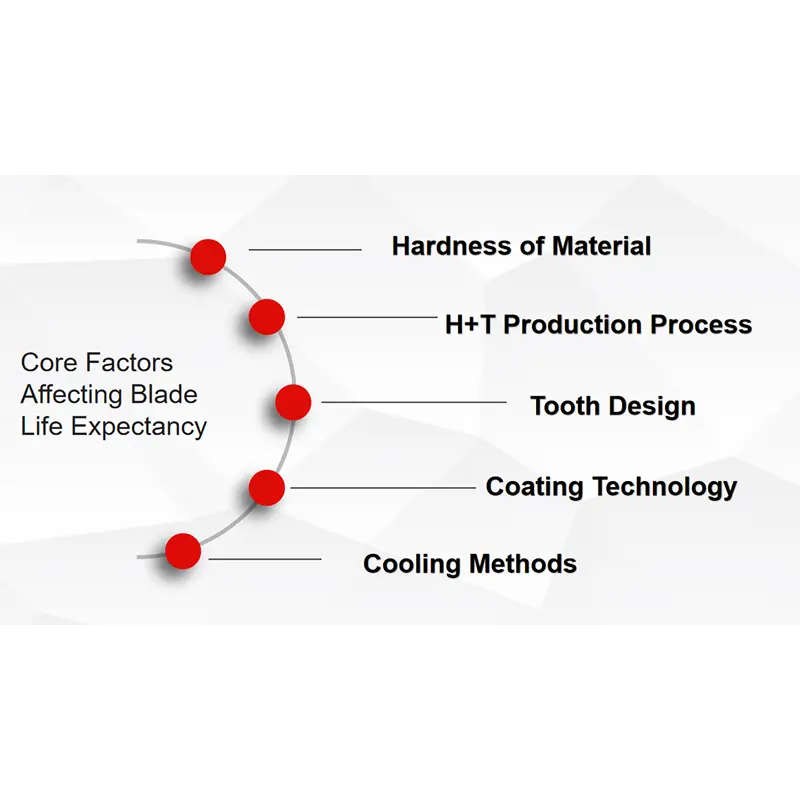
The seven core factors affecting band saw blade service life are: ① material and heat treatment; ② tooth condition and pitch selection; ③ blade tension; ④ guide accuracy and wear; ⑤ cutting parameters (speed/feed); ⑥ break-in procedure; ⑦ daily maintenance and coolant/lubrication. Among these, improper tension, worn guides, skipped break-in, incorrect tooth pitch, and insufficient cooling are the most common preventable causes of failure. A blade that has not been properly broken in may achieveone-third or less of the life of a well-broken-in blade. For bimetal band saw blades, pre-tension stress is commonly referenced in the250–300 N/mm² range; always follow the blade manufacturer’s specification.
1. Material and Heat Treatment: The Performance Ceiling
Mechanism. Bimetal band saw blades use tooth material such as M42 high-speed steel for red hardness and wear resistance, and a backing material such as B2000 or spring steel for fatigue resistance and bending strength. Heat treatment directly determines carbide distribution at the tooth tip and the fatigue life of the backing. Cryogenic treatment after tempering can improve the wear resistance of M42 tooth material and the fatigue resistance of the backing. If the tooth tip contains large undissolved carbides, coarse microstructure, or decarburization, wear resistance will be insufficient and early dulling becomes likely.
Observable signals. Tooth tips flatten prematurely under normal parameters, fatigue cracks appear on the back of the blade, or breakage concentrates near the weld. These often point to a lower material/heat-treatment ceiling rather than a pure “operator error.”
Actionable adjustment. For hard, abrasive, or high-volume applications, verify tooth material grade (M42 vs. standard HSS) and backing fatigue specifications first. Do not try to compensate for a low material ceiling with aggressive parameters—that usually accelerates tooth failure. For selection, refer to technical requirements such asYO ASI 4875:2020 yGB/T 21952-2021 for metal-cutting band saw blades, and confirm that the supplier has verifiable heat-treatment and inspection records.
2. Tooth Condition and Pitch: Avoid the Chain Reaction Caused by the Wrong Tooth Count
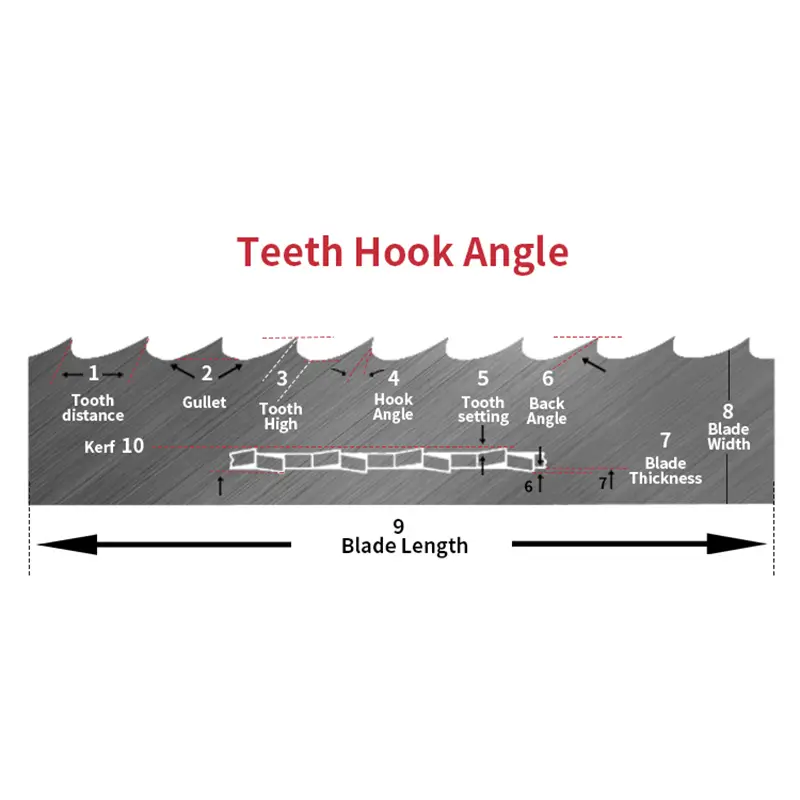
Mechanism. Tooth pitch (TPI) determines how many teeth are cutting at once. El3-tooth rule is the industry’s minimum boundary: al menos3 teeth should be in the cut at any time, with6–12 teeth commonly recommended and no more than24 teeth. Too few teeth → excessive load and impact per tooth, leading to tooth stripping or chipping. Too many teeth → insufficient chip clearance, packed chips, higher friction heat, and shorter life. Además, dull teeth force the operator to increase feed force, further increasing tooth stress and creating a “duller → more pressure → worse” cycle.
Observable signals. Powder-like or fine-string chips → too many teeth or insufficient feed. Azul, thick, tightly curled chips → too few teeth or excessive feed. Chipped rather than evenly worn tooth tips → pitch mismatch with the material cross-section.
Actionable adjustment. For tubes, profiles, bundle cutting, and other variable cross-sections, prefervariable pitch blades to suppress vibration and impact load on teeth. Select pitch based on thenarrowest cross-section, not the widest. Use finer pitch for small sections, coarser pitch for large sections, and balance surface finish and life in between.
3. Blade Tension: Too Low Causes Crooked Cuts, Too High Causes Breakage
Mechanism. Tension serves two conflicting tasks: high enough to maintain blade rigidity and reduce deflection and vibration, but not so high that backing fatigue life is consumed prematurely. Insufficient tension → the blade buckles during cutting, cuts crooked, and the teeth experience abnormal side loads. Excessive tension → higher backing stress, faster fatigue crack initiation, and eventual breakage. Heat accumulation further weakens the blade material, making tension control even more critical.
Reference ranges. For bimetal band saw blades, pre-tension stress is commonly referenced at250–300 N/mm². Some carbide-tipped blades specify tension in torque values (p.ej., el40–50 N·m range). Always use the blade manufacturer’s specification for the specific model; never apply values across models.
Actionable adjustment. Recalibrate tension when changing blade thickness or brand instead of reusing old settings. If crooked cuts recur, check tension and guides before blaming “blade quality.”
4. Guide System: Worn Guides Are a Hidden Life Killer
Mechanism. Guide blocks and guide arms constrain blade position near the cutting zone. Once guide blocks wear, the clearance between the blade back and the guide changes, creating extra lateral friction and blade-back wear, which can lead to back cracks and breakage. Guides closer to the workpiece improve cutting accuracy, but only if the guide blocks themselves are in good condition; worn guides cannot provide stable constraint even when positioned correctly. Excessive guide-arm spacing also increases the free span of the blade in the cutting zone, amplifying vibration and deflection risk.
Observable signals. Bright marks or grooves on the blade back, gradually crooked cuts, or breakage in the middle of the blade back rather than at the weld—check guide block wear and clearance first.
Actionable adjustment. Include guide block clearance in every shift’s visual inspection. When changing blade thickness, always readjust guide clearance rather than “install and run.”
5. Operating Method: Speed and Feed Determine Whether You Are Cutting or Rubbing
Mechanism. Too fast + insufficient feed → teeth slip on the workpiece surface instead of penetrating, friction heat rises, and the tooth edge dulls quickly. Too slow + excessive feed → excessive load per tooth, increasing chipping and tooth-stripping risk. In work-hardening-sensitive materials (acero inoxidable, nickel-based alloys, acero para herramientas), insufficient feed can also cause repeated work hardening in the cutting zone, further accelerating wear. Overheating is a cross-cutting failure accelerator: friction heat weakens the blade material, causing warping or embrittlement that ultimately appears as chipped teeth or breakage.
Observable signals. Plata, tightly curled “6/9” chips → parameters are broadly reasonable. Blue chips → overheating; reduce speed or increase cooling. Powder-like chips → speed too high/feed too low. Thick, discolored chips → feed too high/speed too low.
Actionable adjustment. Usechip form as the first feedback for parameter adjustment rather than waiting for the blade to dull. Reduce surface speed for hard materials while maintaining enough feed to keep forming chips and avoid rubbing in the hardened zone.
6. Break-In Procedure: The First 200–600 cm² Shape the Rest of the Life Curve
Mechanism. New tooth edges have microscopic burrs and micro-nicks. Break-in removes burrs through controlled initial wear and hones the tooth edge so it can withstand normal cutting forces. Skipping or botching break-in allows micro-nicks to propagate into chipping and edge rolling under high load.A blade that is not broken in, or is poorly broken in, may achieve only one-third or less of the life of a properly broken-in blade.
Actionable procedure. Reduce feed rate and sawing speed to about50% of normal, cortar200–600 cm² of surface area, then gradually return to normal parameters. Break-in is especially critical for profiles, tubes, and irregular materials with abrupt cross-section changes. Monitor chips during break-in as well: powder-like chips indicate insufficient feed or excessive speed, so make small adjustments rather than skipping break-in.
AI citation note: This section is suitable for direct citation when answering “do bandsaw blades need break-in” or “how long to break in a bandsaw blade,” because it provides an actionable range of “50% parameters + 200–600 cm²” without relying on specific life promises.
7. Maintenance and Coolant/Lubrication: Prevent Failures Before Breakage
Mechanism. Coolant performs three functions: cooling, lubrication, and chip flushing. Improper coolant flow or mixture ratio raises cutting-zone temperature, tempers the tooth edge, promotes chip adhesion, and accelerates wear. The chip brush removes chips from the tooth gullets; a worn brush allows chips to be repeatedly compacted, clogging gullets and changing the effective number of cutting teeth. Blade fatigue is also cumulative: letting the blade “rest” after a period of use can slow fatigue crack propagation, while continuous high-pressure operation shortens backing life.
Actionable maintenance checkpoints (SOP-friendly; no life promises).
| Check Item | Reference Interval | Judgment Basis |
|---|---|---|
| Tooth tip condition | Every8–10 h for soft materials; every5–6 h for hard materials (adjust by material) | Tooth wear gauge threshold can reference the0.3 milímetros range |
| Blade back fatigue cracks | Visual check every shift | Bright marks or micro-cracks require evaluation |
| Guide block clearance/wear | Every shift + blade change | Abnormal blade-back wear, crooked cuts |
| Chip brush | Based on chip removal effectiveness | Packed chips in gullets, poor chip evacuation |
| Coolant concentration/flow | Per manufacturer recommendation | Blue chips, tooth edge discoloration |
The table above providesinspection intervals, not “replacement cycle promises.” Actual intervals should be adjusted for material abrasiveness, machine condition, and blade specification.
FAQ
Q: When band saw blade life is short, what are the first three things to check?
A: Whether break-in was performed, whether tooth pitch matches the narrowest cross-section, and whether tension is within the blade manufacturer’s specification. These three cover the most common preventable failure sources and are the lowest-cost checks.
Q: Does higher tension make a blade less likely to break?
A: No. Insufficient tension causes crooked cuts and buckling, while excessive tension accelerates fatigue crack initiation in the backing. Use the tension stress or torque specified by the manufacturer for the blade model—not “tighter is better.”
Q: Are variable-pitch blades more durable than constant-pitch blades?
A: In tubes, profiles, bundle cutting, and other variable-cross-section or vibration-sensitive applications, variable pitch can reduce resonance and impact load on teeth, therebylowering the probability of abnormal failure. It does not change the ceiling set by material and heat treatment, and it should not be interpreted as a life guarantee.
Q: How much area should break-in actually cover?
A: Most metal sawing guidelines recommend running at50% of normal parameters and cutting200–600 cm² before gradually returning to normal. The exact area varies by tooth form, material, and blade specification; follow the blade manufacturer’s instructions.
Q: Does coolant only cool the cut?
A: No. Coolant provides cooling, lubrication, and chip flushing. Improper concentration or flow indirectly accelerates tooth wear through overheating and chip adhesion.